Archive for the ‘Lake Tahoe’ Category

By Tim Hauserman
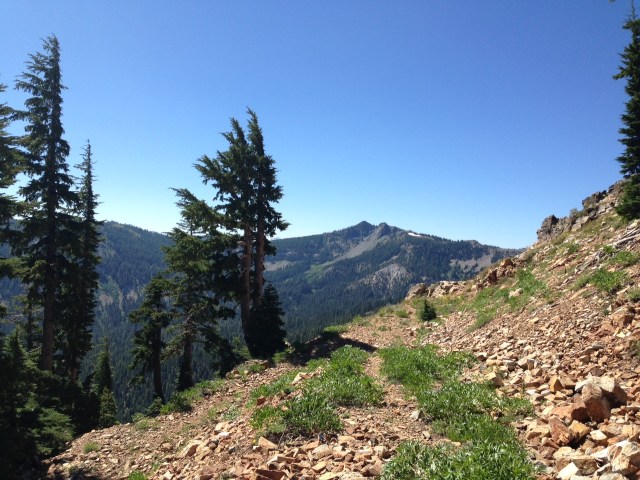
Looking for a Tahoe hike away from the crowds on an August weekend with spectacular views? Try spending your morning hiking to the top of Ward Peak like I did this past Saturday. While I only saw two people, I was treated to views of Ward Canyon, the Granite Chief Wilderness and Lake Tahoe along the route and from the 8637’ summit of the peak.
Begin your hike at the base of Alpine Meadow’s Sherwood Chairlift. To get there: Take Pineland Drive off Highway 89 just south of Sunnyside Lodge, and follow it to a Y and a sign that says “Ward Valley.” Follow the road as it winds through Pineland and becomes Ward Creek Blvd.. Soon you emerge from the houses and enjoy a three mile jaunt along Ward Creek climbing through Ward Canyon. The road becomes Courchevel when you reach Alpine Peaks. Follow to the end where you find parking on your left.
The hike follows the Alpine Meadows maintenance road to the top of the Sherwood Chair. It’s a steady, but gentle climb through open terrain with constant views of Twin Peaks, Lake Tahoe and the Pacific Crest above. Enjoy the soft crinkling of drying mule ears rustling in the breeze, as you rise, the views of lake and mountains seeming to get better with each step. Eventually you reach the top of the Sherwood chairlift and the end of the dirt road.
.

.
Now, take a quick steep jaunt up a slope to the remains of an old cat track, which switchbacks further up the ridge towards Ward Peak. A few steep turns and you reach the open nearly flat ridgeline above the famous F-Tree at Alpine Meadows. After about an hour of steady walking this can be your destination as it gives you 360 degree views of Lake Tahoe, Twin Peaks, Ward Peak, Alpine Meadows, and the Truckee River Corridor.
If you got it in ya’, however, take another 15 minutes of ridgetop climbing to reach Ward Peak’s summit. Follow the obvious route and do a bit of rock scrambling and you will soon enough be atop the peak where you find a bunch of cell towers and a helipad. From here, a whole new panorama opens up of Granite Chief Wilderness and the Pacific Crest Trail below you to the west. Once you’ve had your fill, retrace your steps and go jump in the lake.
.
.
THINK OF ME, LYNN RICHARDSON, FOR ALL OF YOUR LAKE TAHOE AND TRUCKEE REAL ESTATE NEEDS!
.
Share this: Lynn Richardson, Your Friend in High Places

By Tim Hauserman
Once, in my early 20s I went backpacking in Desolation Wilderness with a copy of a book about edible plants of the Sierra Nevada. I was bound and determined to locate wild food that could sustain a person in the wilds of the Sierra. It’s a good thing I brought food, because there was a real dearth of wild foraging to be done, with one exception: The Thimbleberry.
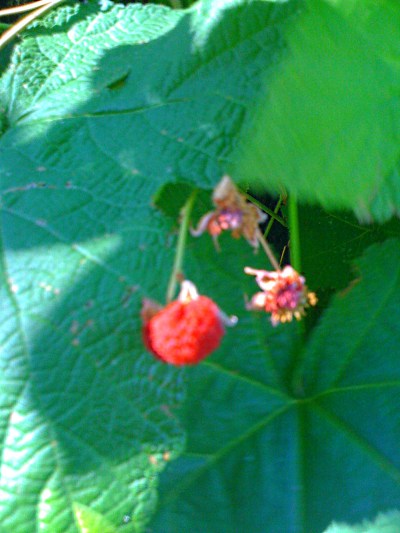
In late summer and early fall, depending upon the amount of moisture we received the prior winter, thimbleberries finally turn bright red and are ready to eat. The name comes from the fact that the berries look like tiny thimbles.
Thimbleberry, rubus parviflorus, is a member of the raspberry family, and while I find raspberries delicious, thimbleberry are just as good, with perhaps a bit more flavor. They are smaller, more fragile, and soft, and thus are not grown commercially, although in some parts of the country they are prized for making jam.
In the Tahoe region, thimbleberries are quite common in the shaded understory of pine and fire trees, as well as near creek beds. The plants grow in the 1-2 foot range for the most part, with large palmate leaves with five lobes. They have a very large similar to maple leaf appearance. The cycle begins with white flowers with yellow centers in the early summer, transitioning slowly through hard green berries to the lush red ones by harvest time.
.
.
A highlight of many an early fall hiking trip for me was to run into a patch of thimbleberries at the height of ripeness. It’s always worth a short break to forage your way through the berries. It’s somewhat of an art to pick the right berry as some are not so tasty or too seedy, while the really red and soft ones are delicious and melt in your mouth.
While thimbleberries are also a popular plant for Tahoe area landscaping, they seem to grow more berries in their natural surroundings, away from all the coddling they get from humans. Which is good, if you wish to savor something as tasty as a thimbleberry, you should have to work for it.
Your best bet for finding thimbleberries right now is at the higher elevations, as the berries at lake level are almost gone.
THINK OF ME, LYNN RICHARDSON, FOR ALL OF YOUR LAKE TAHOE AND TRUCKEE REAL ESTATE NEEDS!
Share this: Lynn Richardson, Your Friend in High Places

.
By Tim Hauserman
Ah yes, there we are merrily enjoying the beauty of the waning Tahoe summer when they arrive. Swarms of them, we can hear them in the forest, we can see them all around, and if we get between them and our food they may choose us as their evening punching bag. Yellow jackets. Not Tahoe’s favorite animals. Especially when you are camping in the forest or throwing some chicken on the barbie. They do, however, consume massive quantities of other pest insects and apparently whether we like it or not, are a part of the mountain ecosystem.
Since we are stuck with them, I suppose it is a good idea to understand them. First, yellow jackets are not bees, they are wasps. Predatory wasps of the genera vespula dolichoespula to be exact. Females are capable of stinging with their lance like stingers that have small barbs on the end. Similar to bees, they are not a threat to humans, unless you have a reaction to the venom, in which case they can send you to the hospital.
Yellow jackets live in colonies in tree stumps, soil cavities or nests. The weather in the spring helps decide what sort of a yellow jacket season we will have. Cold, wet springs can wipe out the queens, giving us a respite from the little buggers. This was not a cold, wet spring, so we got em all over the place this fall. While the nests are formed in the spring, it is in the mid-summer when the adult workers emerge to forage for food. This is when they bring food back to the nest, which enables the queen to expand the nest rapidly, creating wasps like crazy. Once the wet and cold arrives in the fall, the yellow jackets die off and their nests do not make it through the winter.
.

.
How to keep the infestation down to size?
-Yellow Jacket traps can be found at hardware stores. Don’t scrimp. Get more then one and place them in your yard, especially near garbage containers and the BBQ.
-They are attracted to sugary drinks and may fly into a can. Pour the drink into a cup so you know if a yellow jacket has decided to take a sugar swim.
-If you find a nest near your home, you can contact a pest control company to eliminate it.
-When eating outdoors in areas where yellow jackets are active. Cover all food until you are ready to eat. You can build do it yourself traps with a coffee can. Put soapy water in the bottom. Put a stick with a piece of meat on the top. Once they eat they drop into the water and can’t get out.
Treating a sting:
For most a yellow jacket sting is painful, but not threatening. Wash the area with soap and water. Apply cold water or ice to the site, perhaps with a bit of meat tenderizer. Take Benadryl to reduce swelling and deal with a reaction.
Often if there is one yellow jacket sting, their buddies get excited and don’t want to miss out on the action. This is when things can get dicey. If you are allergic, seek medical help right away. Especially if you are the victim of more then one sting.
.
THINK OF ME, LYNN RICHARDSON, FOR ALL OF YOUR LAKE TAHOE AND TRUCKEE REAL ESTATE NEEDS!
Share this: Lynn Richardson, Your Friend in High Places







 YOUR FRIEND IN HIGH PLACES