By Tim Hauserman

High Camp. Photo from Squaw Valley’s Facebook page.
Do you think that perhaps it might be time to drain the pool?
Hey we didn’t get a lot of snow last winter, and we’ve had a gloriously mild fall with an abundance of great hiking and mountain biking, so we don’t have to worry about getting our houses ready for winter, right? Ummm…wrong. In fact it was below freezing this morning as I write this and storms are definitely on the way. Here are a few things you need to do asap to protect your house and property:
Walk around the yard. What do you see? Are you Ok with everything you see being buried under the snow? Now’s the time to get those kayaks, canoes, and lawn furniture into storage or at least underneath a deck.
2) Landscaping system: Turn it off and drain the pipes. If the water remains in the pipes they might freeze and subsequently break. Do you have a hose still attached to the house? Disconnect and drain it.
3) Learn how to shut the water off to your house, and make sure if you are not there, instructions are provided for others. Some individual fixtures such as dishwashers, washers etc..have separate water shut off systems allowing you to shut it off to the fixture if there is a problem, and still have water in the rest of the house. If you have an older home without a shut off valve, have one installed by a plumber.
4) Cover the air vents leading to the crawl space below your house. This will help prevent pipes from freezing.
5) Open cabinet doors under sinks to get heat to piping. This is especially important with older homes.
6) Turn the heat on and keep the thermostat set above 50 degrees throughout the winter months. If you leave the house for an extended period of time, winterize the house by turning off the water and opening the faucets to drain all the water out of the pipes.
7) Prevent Bear Intrusions: Unfortunately, bears getting into homes in the area are now a year round concern. Close all window shades so bears cannot see your refrigerator. Remove any garbage from the house and garage and put it in the bear proof garbage container. If you are leaving for an extended time, remove smelly perishable food from the refrigerator. Be sure that all of the doors to your house are secure with strong hinges and deadbolt locks. Close the doors inside the house so that if the bear gets into part of the house, it will only focus on where the food is and not damage the rest of the house. Consider electric fencing designed for preventing bear intrusions, it has been proven to be very effective.
THINK OF ME, LYNN RICHARDSON, FOR ALL OF YOUR LAKE TAHOE AND TRUCKEE REAL ESTATE NEEDS!
Share this: Lynn Richardson, Your Friend in High Places
Contributing writer, Michelle Portesi ~Kitchen, Bath and Interior Designer
So you’ve made the decision to sell your house. While it’s a simple task to call the real estate agent to get the house on the market (…like Lynn Richardson, Your Friend in High Places!), appealing to potential buyers is a bit more daunting.
As a designer, the following suggestions seem incredibly obvious to me. I’m always surprised when it isn’t obvious to others. So here are a few tips.

Bite the Bullet. Call for a Dumpster.
GET RID OF YOUR JUNK
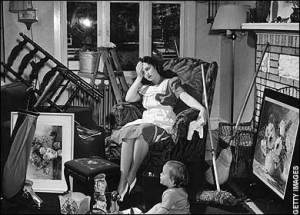
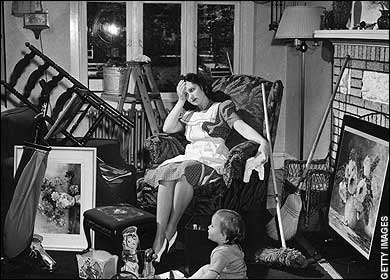
Seriously. I mean it. Homes accumulate an amazing amount of detritus. From random boxes to broken appliances and furniture, these items seep their way into every closet, garage, nook and cranny. Not only do they rob you now of useable storage, they give a buyer the impression that the home doesn’t have enough storage – in addition to making the place look like a candidate for one of those ‘Hoarders’ shows.
Outside, remove dead trees and weeds. Out go the old tires and rusted out swing sets. Don’t wait UNTIL the house sells to do this admittedly tedious task. You’re just prolonging the inevitable, and will inevitably prolong the sale of your house.
Bite the Bullet. Call for a Dumpster.
.

…make it ‘go away’…
PACK UP YOUR ‘STUFF’
Home buyers often can’t see past your personal items and tastes to visualize themselves in a home. Make it easier for them. Box up your prized deer head collection, vast salt & pepper shaker fetish and the family photos. Trust me, you can live without them until your home sells. Keep the most spectacular art pieces and decorative items out for display. Just remember that less is definitely more.
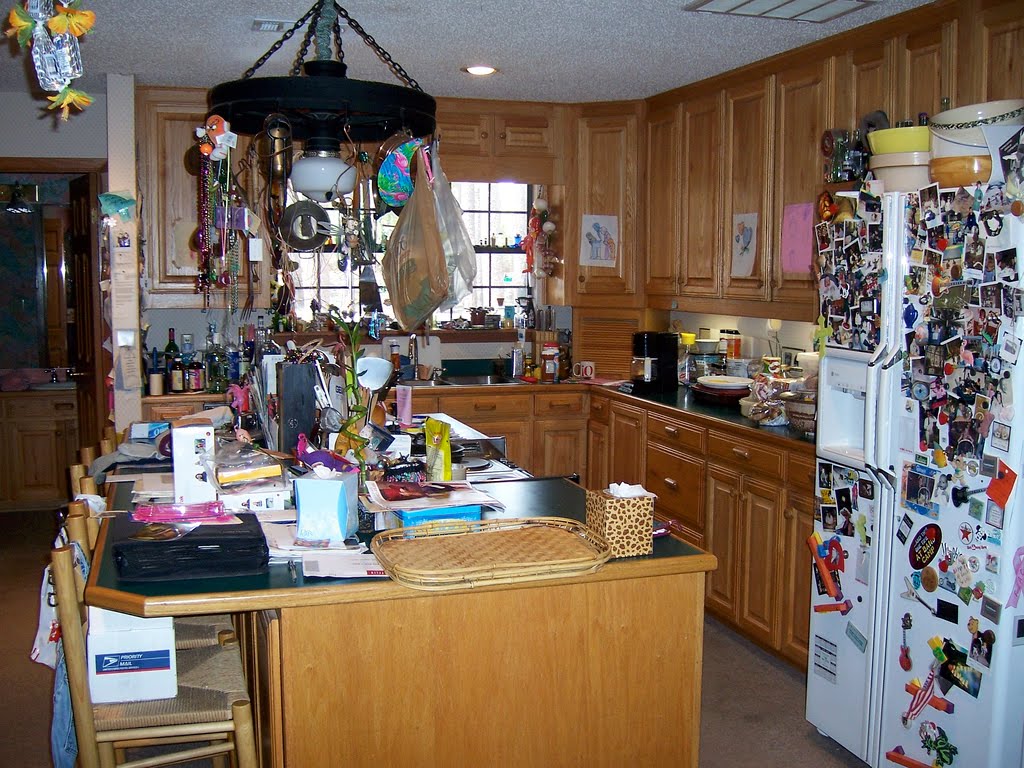
In the kitchen, clear off your countertops and remove all items attached to your refrigerator door to cut down on the visual clutter. Try to keep the area mess free for real estate showings.
If your home looks more like the set of ‘Romper Room’ than a home an adult would feel comfortable living in, try to keep the kid stuff to a minimum. Remember, the whole idea here is to sell your house quickly, so your kids will be back to blissfully riding their big wheels at your new home.
.
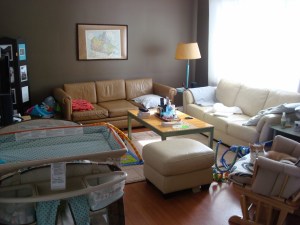
Take out about 50% of what’s in this room.
MOVE ‘EM OUT!
Remove some of your furnishings. Homes are often packed to the gills, and the sheer overabundance can make a house seem much smaller than it really is.
Take out items that are rarely used, and anything over-sized – like a sofa and loveseat combo that doesn’t fit the proportions of the house. Try living with just the sofa. Definitely remove anything that looks worse for wear.
Arrange furnishing into conversation areas, instead of fixated on the television. Walkways and traffic patterns should be clearly defined and should not run through the middle of your furniture zones.
.

Sticker laden purple walls probably won’t appeal to a potential buyer.
TONE IT DOWN
Make the house appeal to as many buyers as possible. Realize that the majority of souls walking through your door may not be as enamored of the Barney purple walls as you are. Neutral paint colors like Kelly Moore’s Mission Tan has a warm medium tone that looks rich, makes artwork pop from the wall and goes with just about any decor. Add more vivacious colors with accent pillows and decorations.

DIY curtains from bed sheets
IT’S THE LITTLE THINGS…
Making a house feel inviting doesn’t have to be expensive. Get creative! Avant-garde arrangements of manzanita branches or pine boughs create fresh floral arrangements that are readily available in most yards. Give your bedroom linens a feeling of sumptuousness with a homemade duvet cover and curtains made with inexpensive sheets. Capture a buyers interest enough to linger in the house. Keep it light, airy and clean.
…and Fresh Baked Chocolate Chip Cookies fresh out of the oven doesn’t hurt either…

Make a house smell ‘homey’.
Shameless plug: And if you truly just can’t visualize the above, contact me and I’ll come over and stage it for you! ~Michelle

Share this: Lynn Richardson, Your Friend in High Places
.

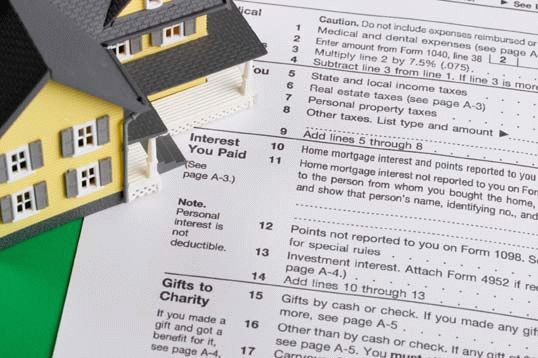
I ran across this excellent article by Lew Sichelman on tax benefits for second homes and how the laws have changed regarding those homes. The article touches on topics such as primary home vs vacation homes, tax benefits of renting out your vacation home, a vacation home that you rent out but still use personally, and vacation home write off expenses.
Here’s an excerpt:
Primary Home vs. Vacation Home
Obviously, if and when your vacation property becomes your primary residence, you are entitled to all the benefits ownership entails. You can write off the interest paid on your mortgage and your property taxes, and you can add the cost of any improvements you make to your basis, or cost.
Moreover, after you’ve lived in your holiday house as your main home for two years, you can exclude up to $500,000-$250,000 for single taxpayers-from the capital gains tax when you sell the place.
If your vacation house is not your primary residence, mortgage interest and property taxes still can be written off, and you still can add the cost of improvements to your basis. But since the capital gains exclusion is limited to your main home, that benefit is not available when you sell.
Some people used to skirt around that limitation by selling their primary residence and moving into the second home. After living full-time in the former vacation for two or more years, they then could sell the place and qualify for the entire capital gains exclusion.
As of Jan 1, 2009, though, the tax law differentiates between the amount of time the house was used as a vacation home or rental property and the period it was used as a principal residence.
The rules do not apply to vacation homes purchased before Dec. 31, 2008. But after that, the rules distinguish between “non-qualified” periods of rental use and “qualified” use” as a principal residence. The minimum period necessary to qualify as a principal residence – two years out of the five years preceding the sale – still applies, but now you’ll have to allocate any gain between periods of qualified and non-qualified uses.
Again, this is complicated stuff, so be certain to consult with a tax professional. Meanwhile, let’s move on the tax benefits of renting your vacation property.
A lot of great info on this article. To read the rest, go here: Second Home Buying –
Practical Tips and Articles for Buying a Second Home
THINK OF ME, LYNN RICHARDSON, FOR ALL OF YOUR LAKE TAHOE AND TRUCKEE REAL ESTATE NEEDS!
Share this: Lynn Richardson, Your Friend in High Places
















 YOUR FRIEND IN HIGH PLACES